Search



With the economy looking the way it looks, and with the cost of new vehicles too unrealistic for many Americans to consider, more people are weighing up extended vehicle warranties—which, technically speaking, are vehicle service contracts.
With so many options available, from manufacturer-backed extended protection to dealer warranties and third-party plans, how do you know what’s reasonable to pay and what’s a total rip-off?
Most of the time, the answer comes down to your personal context. Your car, the level of coverage, how long it will last, the deductible, and more go into the cost. Here’s what you need to know.
How Much Is an Extended Car Warranty Per Month?
On average, extended warranties can be anywhere from $50 to $200+ per month, and there’s a lot that goes into that number:
- Level of coverage: A basic plan costs less but has very limited coverage; a more comprehensive plan costs more and covers more.
- Source of the contract: Dealerships usually place high markups on extended warranties, while manufacturer-backed plans can be more expensive. Purchasing directly from a third-party provider may be the cheapest choice, but that’s not a given.
- Vehicle make and model: Covering a Bentley Bentayga is exponentially more expensive than covering a Toyota Corolla.
- Age and mileage: Older cars with higher mileage are more at risk of breakdowns, which translates to a more expensive extended warranty.
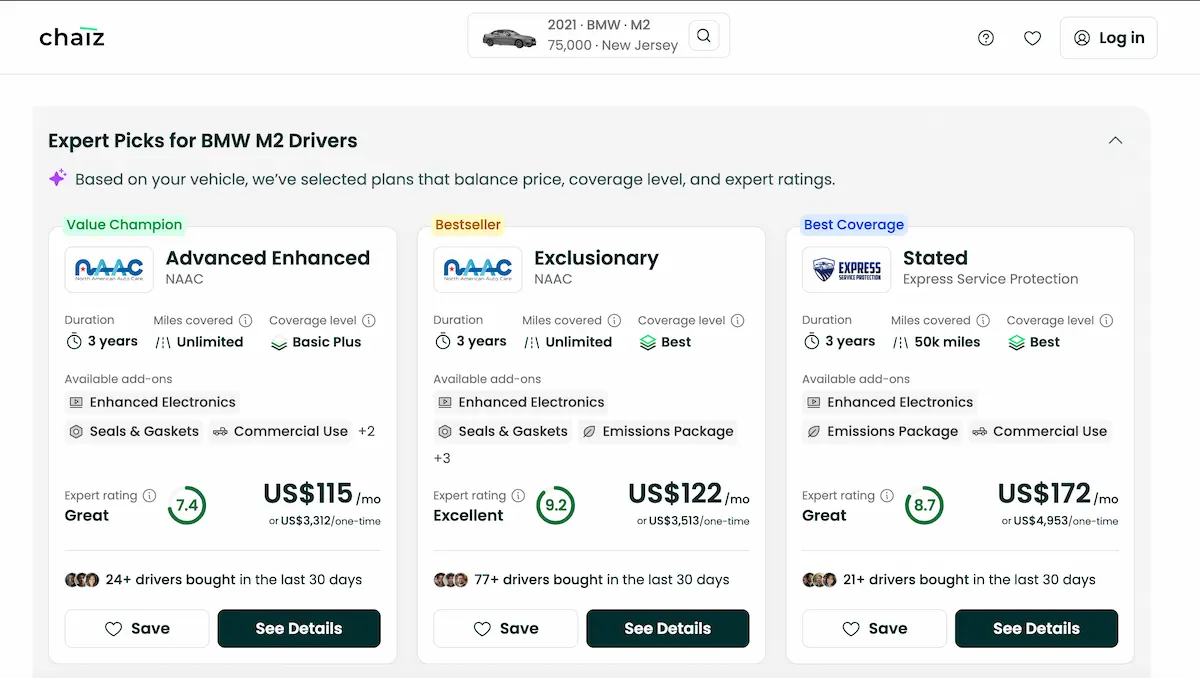
There’s more that goes into the cost of an extended warranty, and we’ll get to that soon. For now, here are some real monthly figures using quotes aggregated from Chaiz’s comparison tool:
What Affects the Cost of an Extended Warranty?
There’s a reason you don’t see providers advertising prices. Two cars with the exact same model year and number of miles on the odometer will still receive different quotes. That’s because age and mileage interact with many other factors to determine the cost of coverage.
These are some of the main variables.
Level of Coverage
Vehicle service contracts differ from factory warranties in a few ways, but for now, we’ll focus on one: the level of coverage.
A new car comes with a factory warranty that consists of two main categories of protection:
- Bumper-to-bumper warranty: Also called exclusionary or comprehensive coverage, this warranty is shorter-term (often about 3 years/36,000 miles depending on the manufacturer), and it covers most components between the front and rear bumpers.
- Powertrain warranty: Usually active for longer (common terms being 5 years/60,000 miles), the powertrain warranty covers the engine, transmission, drivetrain, and axles.
Extended-warranty providers have their own tier systems. Some have six or more plans; others have fewer. These are the three levels you’ll normally see:
- Powertrain: Similar to the manufacturer’s warranty, this only covers the major mechanical components that make a car move. Monthly prices can be anywhere from $50 to $99, possibly more depending on the provider.
- Mid-level: These plans include more systems and components than basic coverage, but they aren’t as comprehensive as top-tier plans. Monthly prices tend to fall into the $75 to $149 range.
- Comprehensive: This is the closest comparison to a factory bumper-to-bumper warranty. Plans cover an extensive number of components, and monthly prices start at $85. On the high end, you could pay from $200 to $400+ per month if you own a luxury or European vehicle.
Although basic plans are cheaper, there are trade-offs worth weighing up before accepting a quote. While expensive systems like the engine and transmission are covered, electronics and other important components usually aren’t.
The best move is to compare what each plan covers and excludes in conjunction with a price comparison.

Age and Mileage
You’re probably familiar with the concept of risk when it comes to insurance. Extended warranties aren’t too dissimilar, as providers weigh up the risk of covering a vehicle when determining the quote. One of the biggest contributors to that risk evaluation is a vehicle’s age and mileage.
Older cars with more miles on the odometer are more prone to breakdowns. From the eight-year mark, the likelihood of big repairs jumps from less than 20% to more than 30%, and that only increases as the car gets older.
The nature of those repairs is also significant. We’re not talking about a quick $200 fix; we’re talking about major repairs that add up to thousands. An OEM transmission replacement on a Toyota RAV4, for example, could cost from $7,500 to $11,000 or more.
From Chaiz data, here’s how the average total cost of plans compares across mileage bands:
- Under 40,000 miles: $3,315
- From 40,000 to 80,000 miles: $3,847
- From 81,000 to 120,000 miles: $3,845
There are fewer providers that offer coverage for cars over 10 years or 150,000 miles. These plans can cost as much as $229 to $400+, and the more limited pool of providers means there’s less room to shop around.
Deductible
A higher deductible can bring down the cost of an extended warranty, whereas a lower deductible can increase it. There are trade-offs to both. The lower monthly payment is appealing, but a $200 or $250 deductible can pinch your budget at the time of a breakdown.
You’ll usually have a choice, with $0, $100, $200, and $250 being common options. There are exceptions. For example, Endurance places a non-negotiable $500 on its Supreme Highline plan, which covers luxury and European vehicles.
When you’re comparing providers, also check whether it’s a per-visit or per-repair deductible. Paying $100 for a breakdown that requires multiple repairs is very different from paying $100 for each of them.
Contract Duration
The length of the contract also affects how much it will cost. With vehicle service contracts, there are two factors at play: the number of months and the number of miles. The contract ends with whichever you reach first, similar to a factory warranty. The total cost of plans with more extensive time and mileage limits is usually higher.
Before signing the contract, clarify whether the duration starts from the in-service date or the date of coverage. If the plan takes effect from the in-service date, then a 5-year/60,000-mile plan only covers your vehicle until it’s 5 years old. It’s not 5 years of protection from the date you sign. The same goes for the mileage.
Check first. With vehicle service contracts, not understanding exactly what you’re purchasing can lead to some very expensive misunderstandings.
Fees to Look Out For
There are three standard administrative fees to look out for:
- Some providers charge an activation fee, which can range from $50 to $200.
- Cancellation fees may be regulated at the state level; a normal range is from $25 to $100.
- If you transfer the contract, there may be a transfer fee of $50 to $150.
These fees are normal, but unexplained or abnormally high fees are red flags. When considering a provider, ask for all the fees to be provided in writing. Look at the fine print too. You may see the $75 cancellation fee that’s bolded but miss the clause stating that cancellations after 30 days come with an extra $250 charge.
Other Terms and Fees to Check
You may be charged a diagnostic fee even if the problem is covered. This could cost between $100 and $200, maybe more. The contract may state that the fee will be reimbursed if it’s a covered breakdown; however, this isn’t a given.
There’s also a chance you’ll be required to pay the teardown cost if it’s discovered that a problem isn’t covered. The provider should make this clear in the contract, but many vehicle owners miss it and are surprised when the expense falls on them.
How Does Car Make Influence Cost?
Compare a quote for a 2021 BMW M2 with a 2021 Toyota Supra, and you’ll quickly see how vehicle make influences cost. Using output from the Chaiz comparison tool, here’s what you’d pay for two plans from Omega Auto Care and Express Service Protection (ESP):
European and luxury cars are more expensive to cover because of the higher cost of parts and higher labor rates. Mainstream makes like Toyota, Honda, and Hyundai usually cost less. To an extent, that’s because parts are more accessible and repairs aren’t as specialized. The lower cost can be affected by reliability too.
Extended Warranty Cost by Car Make
Make, as the BMW M2 vs Toyota Supra example showed, can have a significant effect on the cost of an extended warranty. These are some make-specific averages:
- Honda: $700–$2,000+
- Toyota: $1,000–$4,000+
- Hyundai: $1,800–$3,500+
- Ford: $1,300–$7,000+
- Audi: $3,700–$8,000+
- BMW: $2,200–$7,500+
There are a lot of variables that go into those estimates, and what you’re quoted will be unique to your vehicle specifications, deductible choice, coverage terms, and plan level.
Used-Car Extended-Warranty Cost
A used car is simply a car that’s been pre-owned. The car in question can be relatively new and still under factory warranty; it can also be over 10 years old. An extended warranty on a newer car with lower miles may be cheaper than a warranty on an older car with higher miles.
Checking the warranty by VIN is a quick, accurate way to monitor coverage status and see whether the vehicle still qualifies for a manufacturer-backed extended warranty. Providers may also use the VIN to check past recalls, theft reports, accidents and damage, and more. The findings can influence the quote they give you.
Is the Factory Warranty Still Active?
Depending on the age and mileage, the car could still be under factory warranty. This means you’d be able to purchase a manufacturer-backed extended warranty, or at least explore the option while comparing quotes from third-party providers.
The quickest way to check whether the warranty is active is to use a VIN-based lookup. You could also contact the dealer or manufacturer to find out.
Manufacturer-Backed Plan vs Third-Party Provider
If the factory warranty is still active, then you have a choice between manufacturer-backed plans and third-party providers. There isn’t a hard rule on which is cheaper. Some manufacturer plans are more affordable than purchasing from an independent provider. At the same time, others can be more expensive.
These are some rough price points for manufacturer-backed plans, using the average for each added year of coverage rather than the plan total:
- Honda: $300 to $600
- Toyota: $170 to $500
- Hyundai: $360 to $700
- Ford: $700 to $1,400
- Audi: $1,000–$1,400
- BMW: $900 to $1,700
Compared to third-party warranties, which typically cost between $600 and $1,000 per year, some manufacturer-backed plans can end up being the cheaper option.
If the factory warranty on a new or used car is no longer active, then third-party providers become the only option for extended coverage.
There is an exception that applies to used cars. If you purchase a certified pre-owned car, the car typically comes with a limited extended factory warranty. It’s not an additional plan you purchase separately; rather, the cost is built into the price of the car.
Extended-Warranty Provider vs Dealer Cost
Regardless of whether you’re buying new or used, a dealer warranty will almost always be more expensive. That’s because most dealers put a markup, which can be as high as 400%, on the contract price.
With manufacturer-backed plans as well as used cars that no longer qualify for extended factory cover, the dealer is often reselling plans from another administrator or manufacturer program. Individual dealers then place their commission on top of the company’s cost.
That’s why you can go to two different Ford dealers and be quoted completely different prices. It’s also why you should shop around for quotes instead of accepting the first offer you receive.
Purchasing directly from the provider, if possible, usually costs less. Some, like Zurich, are only available through dealerships, which is why that’s not always an option.

Is the Cost of an Extended Warranty Negotiable?
At a dealership, yes. Most dealers are keen to sell the extended warranty and will lower their price if it means making the sale. If you’re trying to purchase a manufacturer-backed plan, then you can compare prices from different franchised dealers.
Chrysler, Dodge, Jeep, Ram, and Fiat owners can purchase factory-backed plans through the official Mopar website. If you own another make, you may also be able to purchase an official plan from an authorized online volume dealer. These plans won’t be negotiable in the same way a dealer warranty will be, but they cost a lot less.
When purchasing directly from a third-party provider, the quoted price will be more structured. However, because these plans are often customizable, there is a bit of room to negotiate. You may decide on a higher deductible, for example, or reconsider add-ons. Occasionally, providers also offer discounts and promotional deals.
Average Extended-Warranty Cost 2026: Is It Worth It?
Is paying $1,000 or more a year for an extended warranty worth it? That depends. Here’s when the price is worth the peace of mind:
- the cost of repairs is likely to exceed the cost of the plan
- the car is nearing or over 100,000 miles
- the make and model are known for being unreliable
- you own a luxury car
- you plan to keep the car for three years or more after factory powertrain cover ends
Be careful when comparing quotes and sample contracts, and be on the lookout for red flags and high-pressure sales tactics. These are some tips for shopping for coverage:
- Compare apples with apples. Assess the cost for the same level of coverage from at least three different providers to see what’s standard and what’s most cost-effective.
- Don’t sign off on the cheapest quote just because it costs the least. Get everything in writing, and read the sample contract, including the fine print.
- Steer clear of “today only” sales tactics and unsolicited sales calls.
- Check the dealership paperwork carefully. They sometimes slip in an extended warranty without disclosing it.
- Keep maintenance records on file and follow the manufacturer’s prescribed service schedule. Claims are often denied because of incomplete records.
The Takeaway
It’s wise to be cautious when purchasing extended coverage, and knowing whether pricing is reasonable or not is a good starting point.
With that said, price alone shouldn’t be the deciding factor. Many drivers opt for manufacturer-backed service contracts despite the higher price point (in some cases). That’s because they would rather have a factory-trained technician working on their vehicle.
In other cases, it’s less about whether the plan is from the manufacturer or a third party and more about business reputation and how claims are handled. Other times, it’s about who can provide the coverage you need.
Weigh up everything, not just the dollar amount. A low monthly cost won’t be much help if the problems your car is most at risk of aren’t covered.

Jozi Wiltshire