

.svg)
.svg)


Spam can put people off comparing extended-warranty quotes. Find out how to source quotes using spam-free platforms like Chaiz.
Spam can put people off comparing extended-warranty quotes. Find out how to source quotes using spam-free platforms like Chaiz.
You open your browser, type in “extended warranty quotes,” and open up a comparison site. You go straight to the quote form, fill it out, and click “submit.”
And then the calls start. Your phone rings more over the next two hours than it has all week.
Therein lies one of the biggest problems with purchasing extended coverage for your vehicle: the sheer amount of spam.
But Chaiz offers a way around it.
We’ll get to no-spam extended-warranty quotes in a bit, but first: How can you get quotes, what information is actually needed, and how do you know when businesses are violating consumer-protection laws?
The type of extended-warranty company you’re getting a quote from influences how your personal information is likely to be treated.
There are two common routes when sourcing quotes, and you can kick both off online:
It’s tempting to click on the first extended-warranty comparison site you see, fill out your information, and wait for the quotes to show up.
That’s often a one-way ticket to spam central.
Comparison sites and marketplaces share the contact information you fill out when completing online forms. Various third-party warranty providers then use the information you input to generate competing offers, send them to you, and get you on a call to push the quote into a sale.
You can get quotes using service providers’ websites, but many of them ask for your email address or contact number.
Contacting service providers directly might seem like a sound strategy compared to sites that sell your data, but it will still involve fielding phone calls or emails.
A salesperson will probably follow up and say they need more details to provide an accurate quote. They may also do a follow up if you don’t act on it. That’s part of the process of converting your interest into a sale.
If you want to avoid filling out an online form, you can contact the customer service department directly. That way, the phone call is on your terms and in your own time.
With any call, ask for the details you discussed to be put in writing.

There are a few things companies need in order to give you an accurate quote.
At a minimum, they need the make, model, and year, as well as the state the vehicle is registered in. You’ll likely also be asked for the VIN, depending on where you source the quote. This might come later, though.
Some providers will ask for more detail. They may want to know about the vehicle’s condition, the environment you drive in, and your driving habits, among other factors.
Aside from the car’s characteristics, the deductible and coverage tier also influence price. Your location, meanwhile, is used to calculate regional labor costs and work out state-specific contract rules.
Your name, email, and phone number—that’s for marketing, and you should be told how your details will be used.
Companies should outline how they use contact information in a disclosure on the quote form. It might also be in the privacy policy, which explains what information will be collected and how it will be used.
Not necessarily.
Using a neutral, spam-free marketplace like Chaiz simplifies matters.
You can pull up extended-warranty quotes by VIN, by license plate, or by make, model, and year. You’ll also need to add mileage and your state, but that’s it. No sales calls and questionnaires before the quotes are ready.
We’ll break down the process in more detail soon.
The extended-warranty industry has traditionally followed the call-center sales model. It could even be argued that it has abused that model, to the point that auto-warranty robocalls were the top consumer complaint filed with the Federal Communications Commission (FCC) in 2020 and 2021.
Scam calls may have decreased in recent years, but spam is still a concern.
Why isn’t a mystery.
Phone calls are popular because they’re effective for conversions. Salespeople can persuade (or push) you into accepting a quote more easily than if you were doing an online-only sale. And while they have you on the line, they can upsell higher coverage tiers and add-ons.
All of those extras turn into a higher commission.
Ask yourself these questions before submitting a quote request:

It’s easy to forget that there are strict regulations around unsolicited marketing calls and emails. In short, businesses aren’t allowed to call or email you without your permission.
But there’s more to it than that. Let’s break it down.
The Telephone Consumer Protection Act (TCPA) requires businesses to obtain your written consent before sending marketing communications to your phone.
There are significant consequences for violations, from hefty fines to class-action lawsuits.
As of April 11, 2025, businesses have to follow the FCC’s new opt-out rules. Specifically, if a consumer expresses a desire to stop receiving calls or texts through any reasonable means, the business has to honor their wishes.
Keywords that need to be honored include, but go beyond, “stop,” “quit,” “cancel,” and “unsubscribe.”
When you express that you want to stop receiving communication, the specific business has 10 working days to act if they want to stay compliant with the TCPA.
Because it does away with exclusive opt-out methods, this update means that it’s now easier to revoke consent.
Some other TCPA-compliance requirements for businesses include:
The Telephone Robocall Abuse Criminal Enforcement and Deterrence (TRACED) Act is a 2019 addition that has given the FCC new tools to combat robocalls. Under this law, the FCC issued a $299.9-million fine against an auto-warranty scam network.
One consequence of violations is that businesses can now be charged $10,000 for each call that breaks robocall laws.
Whereas the TCPA and TRACED Act deal with phone and robocall spam, the CAN-SPAM Act sets the rules for commercial emails.
Enforced by the Federal Trade Commission, the law gives consumers the right to opt out of email communication.
This applies to bulk email as well as any email that’s primary purpose is to advertise or promote a product or service. Violations come with penalties up to $53,088.
There are a few rules businesses need to comply with, but these are the most important ones in the context of extended-warranty spam:
If there are three major laws governing communication with customers, you’d think that extended-warranty providers would be following them. Reputable businesses do.
Others don’t.
That’s why it’s important to know your rights.
Firstly, being informed means you know what to ignore or report. Secondly, if you notice something concerning, you’ll know to steer clear of the provider rather than giving them your money.
Because filling out an online quote form signals interest, extended-warranty providers use your contact information to try to convert you into a customer.
Across industries, many businesses treat the completion of a lead or quote form as a clear sign of consent. But under the TCPA, a customer completing a form doesn’t equal compliance. You need to actively opt in.
Either near the “submit” button or the field for contact details, there should be a checkbox asking for your consent to be contacted through call or text. You should also be asked which type of communication you agree to (SMS, phone call, or email).
Pre-ticked “I agree to receive calls or text messages” boxes don’t equate to consent because you didn’t actually opt in. However, that is a common tactic. If you don’t untick the pre-checked box, companies consider it permission to contact you.
If the provider is committed to honesty and transparency, that box wouldn’t be pre-checked.
Before submitting your information for a quote, ask yourself a few questions:
Although TCPA and CAN-SPAM compliance won’t tell you anything about the quality of the coverage, it does give you a taste of how the business operates.
There are ways to avoid or stop spam calls and emails:
You can also create an email account that you use exclusively for filling out quote forms. That way, all the communication goes to that account instead of filling up your personal inbox.
If you’re getting spam calls, you can join the Do Not Call registry. Adding your number to the list is a way to opt out of receiving most telemarketing calls. If you are on the list and still receive unsolicited calls, you can report them to the FCC.
One thing to know, though: Giving express consent, for example by ticking a box, can override the Do Not Call list.
While spam is still a major issue in the industry, change is coming. New tech-forward companies are reshaping the quote process. Instead of requiring contact information in exchange for quotes, you can see real prices using only car-related details.
Without multiple sales pitches and quotes swimming around your brain, you can make a clear, informed decision.
As the first online marketplace for extended warranties, Chaiz has built a neutral platform that allows customers to compare what’s actually out there.
Without inputting any personal information or creating an account, you can pull up instant quotes from a network of vetted providers.
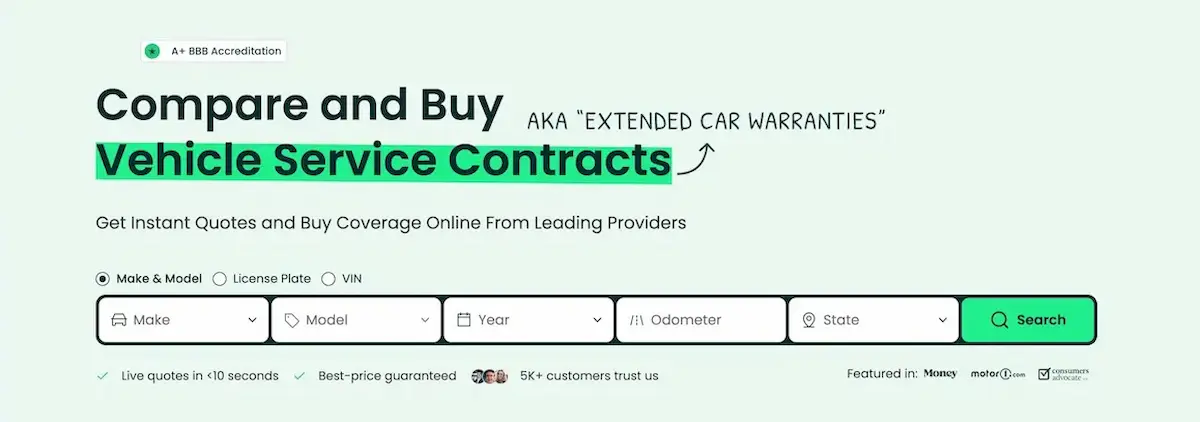
Here’s a step-by-step guide to get started:
A quick disclosure: While we earn a commission when you buy through our platform, we don’t push one provider over another. Chaiz also doesn’t handle the plan itself or set the pricing; we just connect you with providers.
Whether you sourced it through Chaiz, another comparison site, or directly from a provider, there are a few things to check:
If you’ve ever tried to get an extended-warranty or insurance quote before, you probably know the drill. Robocalls, sales calls, emails—it can feel like you’re drowning in spam.
Unfortunately, it could lead to accepting bad quotes. It could also make you stop looking, even after you’ve considered whether an extended warranty is worth it and decided that it is for you.
While you can’t wave a wand and make businesses stop clogging up your inbox, there are ways to minimize the number of calls and emails you get.
Some strategies, like creating burner email accounts, require extra effort and admin. So does carefully checking privacy policies and disclosures. Being careful does pay off in the long run, but there is an easier way.
Give Chaiz a try. There’s no pressure to buy, no sales pitch, and no spam.

Live quotes in <10 seconds
Best-price guaranteed

5K+ customers trust us


